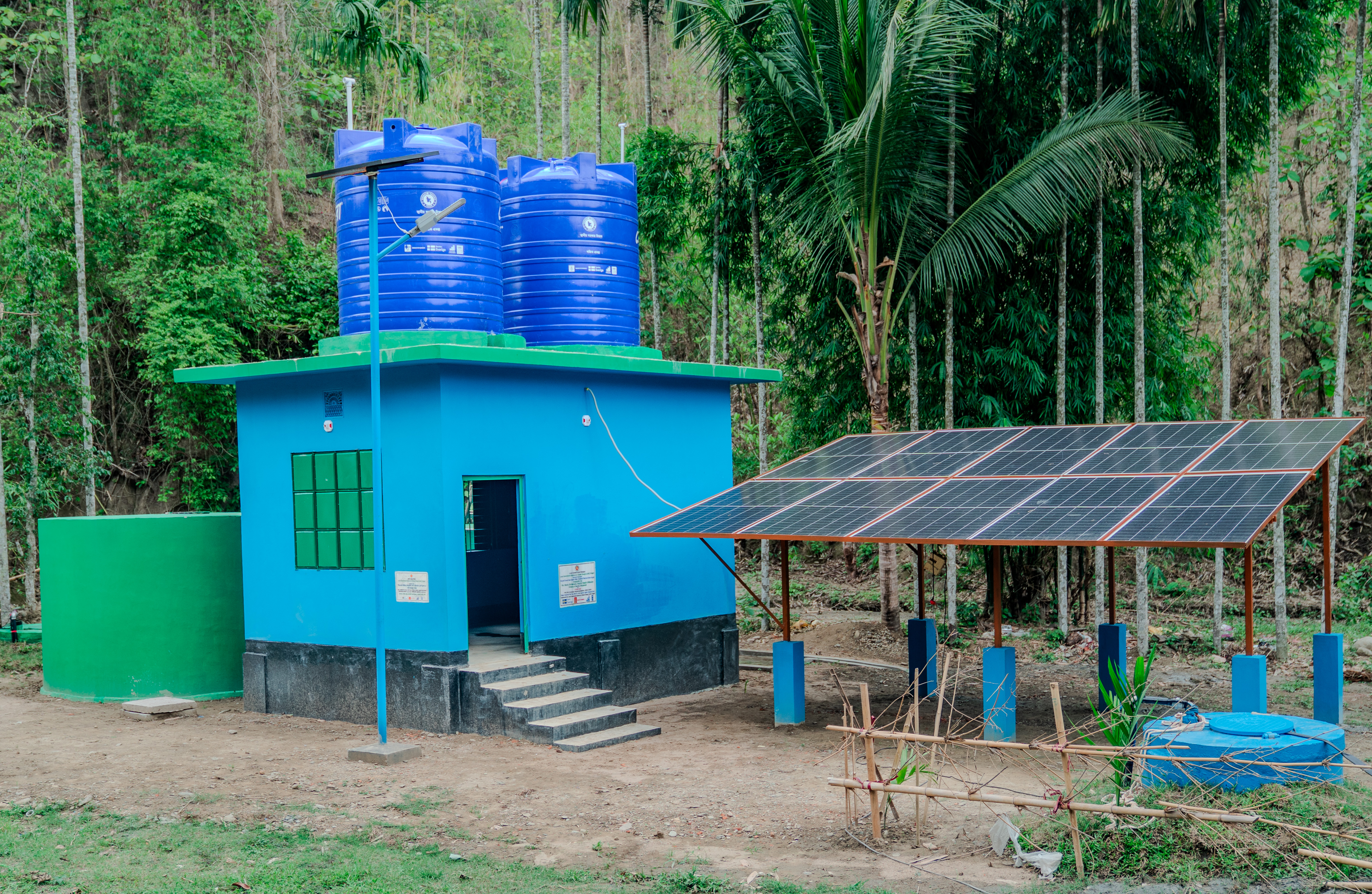
For most of her 84 years, Nayon Tara Chakma began each day with a climb. As the sun rose, she would set out from her mountain home in the remote Bangladesh village of Keronchhari, and scramble up two kilometres of uneven paths to fetch water for her household.
Happily, those arduous mornings are now a memory, as a locally devised investment in a solar-powered water system has brought water to Chakma’s door. This basic but vital infrastructure investment is a locally led, climate resilient solution deployed by the Belaichhari Upazila — Upazila is an administrative unit in Bangladesh. A performance-based grant from the United Nations Capital Development Fund (UNCDF) provided the funds, using an approach developed as part of their signature climate adaptation initiative – the Local Climate Adaptive Living Facility.
“Now that I have water in my yard, I am very happy,” said Chakma, who has lived her whole life in Keronchhari, which lies in hills of Belaichhari Upazila in Rangamati district of Bangladesh’s south-eastern mountains. “At this old age, I can get water in my own yard.”
The Keronchhari village in Rangamati district, like many of the 1000+ Bangladeshi communities where UNCDF deploys climate finance to local authorities, has long been beyond the reach of most public services including water and energy. For financial institutions, it is a place too risky, too costly, and too remote to serve. Climate change has only made things harder. Streams that once supplied water have dried up, leaving women both young and old, like Chakma, to carry the burden of survival and divert their energies from other tasks that might generate income for their families.